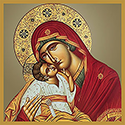
Cultivating Good Soil through the Blessing of Holy Icons
Sermon preached by Dn. Jeff Smith on Sunday, October 11, 2026
In the name of the Father and of the Son and of the Holy Spirit. Glory to God!
Today, we commemorate the Fathers of the Seventh Ecumenical Council, who gathered at Nicaea in the year 787. After Islam had swept North Africa, iconoclasts rejected the use of holy images and stripped churches throughout the empire because they believed that Christians who honored icons were falling into idolatry. A little background here. On 717, the Umayyad Caliphate laid siege to Constantinople, but they were defeated by Leo III, the Isaurian. In 721, the Caliph Yazid issued a sweeping edict, banning images of any living being not only in mosques but also in homes and churches. So Leo followed with an edict of his own, banning the veneration of icons in 726. Then Saint John of Damascus began writing treatises defending icons between 726 and 730. His ideas that he developed were the ones adopted by the council in 787.
The Church's answer was uncompromising: The Word became flesh. That was the focus of the Council. It held for a little while, but then there was backsliding and many of those fathers became martyrs, until the final restoration which we call “The Triumph of Orthodoxy,” which we commemorate on the first week of Lent. So we have today’s Seventh Ecumenical Council and the Triumph of Orthodoxy. They’re connected, but they’re not the same. Constantinople was then attacked again and again for seven centuries until it finally fell in 1453, just 40 years before Columbus set sail to the Americas, and we remember Columbus this weekend. So, back to 787, the Council stated that the invisible God whom no one can see entered history and became visible in the form of Jesus Christ. The Son of God could be seen; he could be touched, heard, and embraced. And because he became man, he can be depicted. The icon therefore became the proclamation of the Incarnation.
We do not worship wood, or paint, or pigment. We venerate the person who is represented. When we stand before an icon of Christ, our prayer is directed to Christ. When we kiss an icon of the Mother of God, our love is directed to her. So the material icon is a means by which we encounter the person represented. It is not an idol or a graven image.
St. John of Damascus expressed this beautifully: He said, “I do not worship matter; I worship the Creator of matter.” God createdthe material world. In his incarnation, He entered the material world. As a result, matter becomes a means of blessing. Water becomes the means of baptism. Bread and wine become communion. Oil becomes another instrument of blessing. And an icon becomes a window through which Christ directs our hearts toward the Father.
St. John said, “No one has ever seen God.” But the Son has revealed the Father. In this way, the icon protects the mystery of the Incarnation.
Today we live in a culture saturated with images. We carry thousands of them in our pockets. We constantly look at photographs, screens, advertisements, videos, faces, landscapes, more advertisements, and carefully constructed versions of other people's lives. We are surrounded by images, but not all images teach us how to see.
The icon teaches us how to see.
The icon says, “Look beyond what is visible.” Look through the material toward the person. Look through the saint toward Christ. Look through the created world to see the Creator.
And that brings us to the parable of the sower, which we heard this morning. We can, of course, vigorously defend icons and fail to see Christ in the person standing next to us.
We can be very good at arguing about things that do not make us more loving, more merciful, more prayerful, or more holy.
St. Paul tells us in the epistle today to “apply yourselves to good deeds.” That is precisely what the icon teaches us.
If we say that Christ is merciful, then let mercy become visible in us.
If we say Christ forgives, then let forgiveness become visible as well.
The icons show us what good soil looks like.
Today, Christ said about those who hear the Word of God, “Hold it fast in an honest and good heart, and bring forth fruit with patience.” A seed does not become a tree overnight, and becoming holy takes time.
The Church has asked us to become a people in whom the truth has taken root deeply enough to bear fruit. Then the greatest icon becomes the human person restored in the image and likeness of God.
When we look at an icon, let us pray: “Lord, teach me to see you.” Teach me to see You in the Eucharist. Teach me to see You in the person who is difficult for me to love. Teach me to see Your image in myself—as a call to transformation.
The Word of God has spoken. What kind of soil will we give to Him?
The Word has been being planted in us. Will we allow it to grow within us?
May we, through the prayers of the holy Fathers, become good and fertile soil so that the Word of God might take root deeply within us, grow patiently, and produce the fruit for which God created us: to be a life of faith, a life of love, a life of mercy, holiness, and communion with God and with each other.
May our lives become living icons—because Christ is being formed within us.
Thanks be to God.