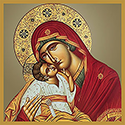
For God So Loved the World that He Gave His Only Son: a homily on the Sunday before the Feast of the Cross
Sermon preached by Dn. Jeff Smith on Sunday, September 13, 2026
When we forgive, we reveal the Cross. When we show mercy, we reveal the Cross. When we refuse to return hatred, we reveal the Cross. When we care for someone who is lonely or forgotten, we reveal the Cross. When we repent and begin again, we reveal the Resurrection.
In the name of the Father, and of the Son, and of the Holy Spirit. Amen.
There are moments when the whole Christian faith seems to coalesce and crystalize in just a few sentences. Today’s gospel is one of those moments. Jesus descends from heaven, is lifted up on the Cross, tells us about the love of God and our salvation in one sentence: John 3:16. Today, I would like to think about that sentence in terms of the phrase St. Athanasius wrote, “God became man so that we might become God.” Let me try to spell it out.
Christ begins by proclaiming: "No one has ascended into heaven but he who descended from heaven, the Son of man who is in heaven." Yes, these words are mysterious. Christ tells Nicodemus something that overturned his expectations: heaven is not reached by climbing. We cannot climb a stairway to heaven. Heaven is open only because God Himself first descended from heaven. The Christian faith begins with the reality that God has come to us. Orthodox Christianity is not about our search for God. It’s really about God’s search for us. This is what today’s gospel is about.
That is the whole logic of the Incarnation. St. Athanasius wrote that the Word became what we are, so that we might become what He is — and Christ tells us this is the only way. Because the Son of Man descended into our flesh, our poverty, and our death, He alone is able to lift us back with Him. He doesn’t show us the way; He is the way. Whoever is united with Him is already ascending to him.
The Son of God descends. He takes on our flesh. He enters into our history. He accepts our hunger, our weariness, and our suffering. The one who is beyond creation enters into creation. The one who created the world is held in the arms of His mother.
The Lord opens with his descending and ascending and compares that to the bronze serpent lifted up on a pole in the Sinai desert (which became a symbol of healing, and we see in hospitals). These are all part of one movement, and if we follow it carefully, this movement will lead us to the foot of the Cross and beyond, to the Resurrection.
Today, we approach the feast of the cross as Moses lifted up the bronze serpent in the wilderness, and those who looked upon it were healed. Jesus says, “So must the Son of man be lifted up, that whoever believes in him may have eternal life.”
The serpent was the form of poisonous snakes that were killing the people of Israel, yet lifted up in bronze, it became a source of healing. So too, as St. Paul wrote, Christ was made to be "sin who knew no sin," — in that He took upon Himself the condition of our death, and hung upon a Cross, so that whoever looks at Him with faith is healed from the bite of the ancient serpent in Genesis. The bronze serpent in the desert could heal the body, but the Cross of Christ opens eternity to everyone.
Christ was lifted up, so that humanity, wounded as we are, can turn our eyes toward Him and live. Notice that as Christ is lifted up on the Cross, He is glorified. The hour of His deepest humiliation is the hour of His enthronement. The Cross is the moment of glory, because it is love's fullest revelation.
The Cross was an instrument of death, yet through the Cross comes life. What appeared to be defeat, is actually victory. What appears to be humiliation is actually glorious. The place where humanity does its worst is the place where Christ reveals His greatest love. And how I wish as a country, we could have responded on 9/11 with this love and forgiveness. What could we be as a country today? Christ was lifted up. He entered death, but death did not contain Him. Think about that in terms of the last twenty-five years of our history.
The Orthodox Church places the Cross directly in front of us. We make the sign of the Cross. We kiss the Cross. We process with the Cross. We put it in our homes. We wear it around our necks because the Cross reveals who God is.
But it’s hard for us to accept the small crosses that come to us every day: these crosses require patience with another person, caring for someone who needs us, admitting when we are wrong, forgiving an injury, giving when no one notices. The Cross shows us that love is something we do with our whole lives.
Christ came to redeem the whole cosmos. He came for the broken. He came for the person who wanders away. He came for the one who thinks there is no way back. He came for us. And we approach God precisely because we need to be healed.
He came down and he entered our darkness. He takes on our wounds. And whenever we look at the Cross, we see the love of God revealed. We see the one who descended, lifted up for the life of the whole world. Our life is learning to live with that love. And having received it, we are called to become the instruments of His love in this world.
When we forgive, we reveal the Cross. When we show mercy, we reveal the Cross. When we refuse to return hatred, we reveal the Cross. When we care for someone who is lonely or forgotten, we reveal the Cross. When we repent and begin again, we reveal the Resurrection.
This gift is free to us; and yet it does not come without cost. Because we are asked to take up our own crosses and let the love that has been lavishly given transform the shape of our being.
This is the meaning of the Gospel. The Son comes as a physician. What remains for us is simply to look at him and live. God has not turned away from us. He has come among us; He has taken our death on Himself and was lifted up before the eyes of the whole world —that we, looking at Him, might live.
Just as the Israelites in the desert had only to lift up their dying eyes to the bronze serpent, so we are asked to fix our gaze, again and again, on the Crucified and Risen Christ — in the Cross venerated, in the Body and Blood that we receive — and to entrust our whole selves to the One who descended for us.
"For God so loved the world that He gave His Only Son, that whoever believes in Him should not perish but have eternal life."
The Son of God became man so that we might receive life, as St. Athanasius said. Christ came to restore what was broken to bring us back into communion with him.
God so loved the world, the world of Adam's children, wandering, bitten, dying. He loved us not because we were lovely, but by being loved, we might become lovely.
He gave the very One in whom the Father is well pleased, the eternal Word who shares His nature and glory. He gave His Son to the wood of the Cross, that we might live.
His gift is given to those who believe — and to believe in Christ is to unite ourselves to Him, to abide in Him, to let His life become the pattern and the strength of our own. Eternal life is participation in God’s life.
The early Fathers understood eternal life as communion — the restoration of what was lost in Eden, when humanity walked with God and was not ashamed. To perish is to remain cut off from that communion. To have eternal life is to be grafted back into the life of the Holy Trinity, to become, as St. Peter wrote, "partakers of the divine nature."
This is the whole aim of the Incarnation, the Cross, and the Resurrection: that we are made capable of receiving communion with God who loves us. Forgiveness opens the door, and our life allows us to follow by walking through that door, into a house not made with hands.
“God so loved the world.” He loved us. Our lives. Our failures. Our fears. "God sent His Son into the world, not to condemn the world, but that the world might be saved through Him." This is how today’s gospel ends. The Orthodox understanding of salvation is really about healing. Sin wounds us. It distorts our vision. It fragments our relationships. But Christ enters into our condition completely. He takes up our humanity, and He destroys death by his death.
So, when we come into the Church, we begin to live differently. We begin to pray differently. We begin to see each other differently. We begin to forgive. We begin to recognize the image of God in people who are difficult for us to love. And Christ continues to give Himself to us today. What remains for us is the labor of our lifetimes - to entrust ourselves entirely to the One who so loved the world that He held nothing back, so that we, believing, might not perish, but live forever with Him. Thanks be to God.