To Love as Christ Loves Us
Sermon preached by Subdeacon JD Swartz on Sunday, September 20, 2026
In the name of the Father and of the Son and of the Holy Spirit. Amen.
Christ is in our midst.
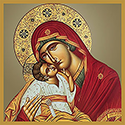
It’s good to be back at St. Mary’s. I was recently gone for two weeks for the residency portion of my Master of Divinity program where we spent our days in services, lectures, classes, and liturgical practice. I enjoyed spending my free time with friends that I have made in the program as well as walking along the trails through the woods of the property as I read “The Gospel of Trees,” a book I would recommend for anyone interested in contemplating ‘nature’ as a fellow worshiper of God. The last morning at residency, the myrrh streaming Iveron Icon arrived in the early hours of the morning and we prayed with it and with the relics of St. Raphael of Brooklyn, and we were anointed with the oil which continually seeps out of the icon of the Mother of God.
Two hours later, I was burning my tongue on an overly-hot coffee at a Dunkees in the Pittsburg Airport, gearing up to return to the normalcy of a full-time job, family, and the studies of a new semester. On the flight, I sat next to a man who used the flight tracker map on the display in front of him to show me every town and village he and his family had visited on their Alaskan road trip last year. He described the condition of every road and highway they traveled, and I learned every issue his family experienced with their motorhome; and I found myself, unexpectedly, interested rather than annoyed that my quiet reading time had disappeared.
As I sat and listened, still able to smell the fragrance of the oil on my hands and forehead, I was struck with the strangeness, not of the contrast between the experiences of that morning but, of the realization that all of the things I was experiencing that morning are the Christian life.
The recognition that there is more to the world than what we see around us in our daily lives does not give us the freedom to abandon those mundane things – encountering Christ demands that we sanctify all that we interact with. Even a monastic will tell you that we cannot set ourselves apart from the world by merely stepping away from it, or simply making intentional communities or our own schools, we set ourselves apart from the world by being Christ to the world. When we approach faith as an intellectual study, or as ethical and moral framing, or as a manner of control rather than as the expression of God’s love, as something to hold for our own rather than to be held by, we risk reducing divine revelation to laws and relationships to concepts.
It's easy to recognize the personhood of our family members and our friends, but what about those we pass in the grocery store? What about the coworkers we disagree with? What about the political “other”? They are not simply concepts, they are people. Our fellow parishioners here, the children making noises during the service (keep it up, kids!), those who we think are either too rigid or not pious enough, should not be seen as impediments to our prayer, they are just people. Our cities, neighborhoods, and communities are not all that is wrong with modern society, they are made of people. For those who engage with Orthodoxy online, the words we read there are not just concepts, they are the expressions of people, they are not simply arguments to be overcome, or heterodox in need of intellectual salvation through our logic. The Fathers and the Saints are not a gathering of quotes, they are people, and using their teachings to attack rather than spiritually feed others is not how we preserve the Fathers, that is how we embalm them; when we weaponize them we drain all that is life-giving from their words. The Theotokos is not a theological concept, she is a person to be met.
We are all people and we all live with a deep and abiding need for the love of Christ, and He is most certainly not a concept to be merely dissected and studied, nor is He an obligation to be given a passing thought for an hour each week during service; for all the theology, history, philosophy, and spiritual guidance that we may read, particularly when first coming into the Church, or for all the generations of our families who have belonged to the Church, we must each come to the realization that Jesus Christ is the unknowable God who revealed Himself as a person. And while it may be easy to see Him here, in His house, if we take the time to look for Him, we will find Him everywhere, even in those spaces and in those faces we think would be impossible. This is the Christian life, encountering Christ at every turn and, by His love, being Christ to all that we encounter, restoring the sanctity of all things.
The flowery language of love might strike some as an over-simplistic expression of the Gospel or an easy path to avoid standards. To that I would say, you do not know love. Two-thousand years ago the One we accept as God told us to love our enemies and do good to those who persecute us, we, instead invented the term “holy war.” Two-thousand years ago the Word of God made flesh said that we would be known as His disciples by our love for one another, and the factions, communions, and fractions have not ceased to grow in number. We have heard the words of 1 Corinthians 13 misused for so long that we’ve stopped paying attention to them so now we care greatly for prophecies which will fail, for tongues which will cease, for knowledge that will pass away, and we have forgotten that without the love which endures all things, we are nothing – and nothing is as close as we can become to the antithesis of the God who is everywhere present and who fills all things. Faith and love require more of us than any law ever could.
Living love is not easy, I know - I am preaching this to myself right now because I fail daily, many times a day. I choose myself, my interests, my self-righteousness, my anger over and over because it is so easy to do. But in today’s Gospel reading Christ reminds us, “If anyone wishes to come after me, let him deny himself and take up his cross and follow me.” Or, to put it a little more bluntly as only a German theologian could, Dietrich Bonhoeffer said, “When Christ calls a man, he bids him come and die."
Love is not puppies and butterflies, and the love that abides is not even the happiness which we so often pursue; love is the slow, repetitious, and unceasing death of the self for someone. In Christianity, as we die this kind of death, we find that we are not losing ourselves, but that we are becoming more truly ourselves as we become more like Christ. “…it is no longer I who live, but Christ who lives in me; and the life I now live in the flesh I live by faith in the Son of God, who loved me and gave himself for me.”
We were not placed on this earth to be correct or be successful or to be the most knowledgeable – though if we are, those are good things, but really what does it profit someone to gain these and lose their soul? We are first and foremost, placed here to love as Christ loves us. And of those not in the Church, St. Marcarius of Optina said, “They do not love you – you love them. The fact that they do not love you does not depend on you; but your loving them is within your power and is your duty…”
May we allow the death of everything in us that is not of Christ, who gave Himself up for the life of the world because He so loved the world. May we lose our lives to, and for, Him so that true life may abound. And may we recognize His life and His love whether we are standing before a myrrh-streaming icon, or in a conversation with a stranger, for each is a gift from God. Amen.