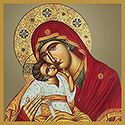
Iconography—Memory and Hope in Visual Form
Sermon preached by Teva Regule, MDiv, PhD on Sunday, March 1, 2026
Antiochian Women’s Month 2026—“Between Memory and Hope: The Special Commemorations in Lent”
Glory to the Father and to the Son and the Holy Spirit—one God. Amen.
By my bed stand is a picture of my grandmother. We called her “Buni” which is short for “Bunica” or “grandmother” in Romanian. She was my primary caregiver when I was very young (as my mother was a fulltime school teacher) and was a constant presence in our home throughout my teen years and into my young adult life. I can remember the time we spent together fondly—playing cards and eating popcorn on a Friday night, making bread and getting to eat the fried dough that was leftover, assisting her with her errands, and listening to her stories and sharing my own—all while engulfed in a presence of unconditional love. She passed away many years ago now, but her picture still evokes her presence and that sense of security and love. It is my hope that we will be together again someday when the Kingdom of God is fully realized.
Between Memory and Hope—this is the liminal space in which we live most of our lives. As Christians, we live with the memory of Jesus Christ and all that He has done for us and with the hope that we too will live with Him eternally. As we walk on our own paths, the Church gives us sign posts along the way to remind us of important events in our lives that ground us as Orthodox Christians and point us to the reality of the Resurrection. This year during Antiochian Women’s Month, we will focus on the particular commemorations that we celebrate in Lent and their value for our journey towards theosis (“God-likeness”)—the benefit of icons and of unceasing prayer, the reminder of the Cross, the “yes” that Mary gave to Gabriel at the Annunciation and the example of the life of Mary of Egypt. Today, I would like to speak about icons—memory and hope in visual form.
As we see, Orthodox Christian worship and life are marked by the use of icons. They are symbols[i]—in the classic sense, that which participates in what it represents—through which the faithful have an opportunity to encounter God and participate in the life of the Trinity. Symbols have been a part of the Christian experience since the time of Jesus Christ. Early believers used a symbol of a fish to identify themselves as Christians and mark their gathering places. The Greek word for fish is ichthus. In addition to its meaning, it is also an acronym in Greek, meaning “Jesus Christ, Son of God, Savior”—the Christian creed in a nutshell. We can still see this symbol used today by those who profess the Christian faith. Early Christians also used the Lamb to represent the sacrifice of Christ (e.g. Rev. 5:6), and the Good Shepherd to represent His care and guidance (e.g. Jn. 10:11, 14). Later, the church adopted more elaborate renderings to illustrate the revelation of God as understood and experienced in the Christian life. For instance, in the baptistery of the earliest house church for which we have archeological evidence, the house church at Dura Europos (in modern day Syria), the walls were covered with paintings of biblical themes. They told the story of salvation, from the Hebrew Scriptures to the Gospel accounts, including scenes of Adam and Eve, David and Goliath, the Healing of the Paralytic, and three women approaching an empty sarcophagus (probably the Myrrh-bearing women). It is likely that these stories helped to instruct the initiates preparing for baptism. We remember them still as they provide the background for the theological understanding of baptism as a new life in Christ. They give us hope that we, too, through our baptism, can experience this new life in its fullness.
From the early church, we see that icons have been used to educate the faithful. John of Damascus says that they are “books of the illiterate… teaching without using words those who gaze upon them, and sanctifying the sense of sight…”[ii] Icons are images that proclaim the Gospel in visual form. However, for the Damascene, icons are not just tools for narration, but function to sanctify the vision of those who look upon them. They allow us to acquire a spiritual vision—to see the world as God sees it—in all its fullness, filled with love. For instance, in the “icon” of my grandmother that I mentioned, I not only see her image, but I see her—her look, her smile, her personality and am reminded of my relationship with her. I not only remember a woman I loved when I was a child and a younger woman and who loved me, but I continue to experience that love in the present on some level and hope to do so more fully at the end of time. Icons allow us to see the world as God sees it—outside of time and space.
Although the icon can be pedagogical, the primary value of an icon is sacramental. It is not uncommon to see an Orthodox believer, talking to or praying with the referent in an icon. I must admit, there have been times when I have looked at that “icon” of my grandmother and talked to her as if she was still here with me. I remember her guidance in my life and hope that I am continuing to follow it as I navigate life’s trials and joys.
Although images had always been a part of church life, in late antiquity, the church struggled with the idea of actually depicting Jesus Christ, the revelation of the Word of God, in visual form. There were those who rejected images of Christ, claiming that the divine nature could not be depicted in visual form. Other theologians, most notably John of Damascus, argued for a visual representation of Christ. Although God the Father still could not be depicted in material form, the Son could be so rendered because of the Incarnation. This debate went on for over a hundred years and fell into two periods. In 726, the Emperor Leo III started the attack on the use of icons. Some sixty years later, in 787, Empress Irene gathered the leaders of the Church in Nicea in what is known as the Seventh Ecumenical Council (the same city where the Nicene Creed had been agreed upon some 450 years earlier) and they vindicated the use of icons and clarified the theology around them. Despite this agreement, some thirty years later, in 815, there was a second attack on icons. This lasted another thirty years, until 843, when the Empress Theodora finally and permanently vindicated the supporters of icons. A new commemoration was established in the Church to remember these events. It is this restoration of icons that we remember and celebrate today. According to David Vermette, one of the former catechists here at St. Mary, this controversy was not only about icons, but it represents “the triumph of Orthodoxy over fundamentalist readings of the Old Testament, against neo-gnostic dualism [i.e. the idea of thinking of the spirit as good and thinking of the material as bad], against [those] who denied the reality of the Incarnation [i.e. those who said that Jesus only appeared to take on human form and wasn’t fully human] and the deification of the body with the soul and the restoration of all Creation… that God said was Good.”
For Orthodox Christians, the use of icons affirms the goodness of creation, the historicity and Truth of God becoming human in the Incarnation, and the ultimate consummation of all things in God. Icons of Christ affirm Christ’s humanity—the God who became one of us. Through the icon, we can remember His ministry—His teachings, His healings, His nuggets of wisdom, His betrayal, His suffering, and ultimately, His death and Resurrection. By remembering His ministry, we can understand more fully what it all means for us. This gives us the hope that we, too, as we walk in the footsteps of Christ, no matter our challenges, will ultimately live with all of our Bunis—and all of those whom we have loved—in the Life of the Trinitarian God.
Amen.
[i] I use the term “symbol” in its classic sense—that which participates in what it represents.
[ii] John of Damascus, “Commentary on a sermon on the Forty Holy Martyrs of St. Basil” in On Divine Images, 39.