Knowing the Unknowable God Through Embodied Prayer
Sermon preached by Dr. Sarah Riccardi-Swartz on Sunday, March 8, 2026
Antiochian Women’s Month 2026—“Between Memory and Hope: The Special Commemorations in Lent”
Glory to the Father, Son, and Holy Spirit-One God. Amen.
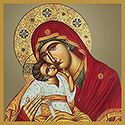
Teva’s beautiful recollections of her grandmother last Sunday drew us into the liminal space between memory and hope, reminding us how images, how icons affirm truths and historicity, while providing material, visual evidence of our communal identity and kinship, whether biological or spiritual. Icons are central not only to the historical evidence of our faith but to our incarnational theology and understanding of salvation. They remind us that salvation is not just a mental exercise but an embodied experience. They remind us that, in the words of St. Athanasius the Great, “God became man, so that we might become god.” Let that sink in. God became man, became human, so that humans can become god. What a wonder!
How do we humans become like God? That task seems too immense for the human mind to comprehend. Perhaps we must start by knowing God. We are fortunate, to have a helpful guide in the figure of St. Gregory Palamas, whom we celebrate today. In the time I have with you, I want to think about St. Gregory’s impact on our lives in his influence on knowing God and prayer, through two of his theological interests: the essence/energies distinction and hesychastic prayer. For some of you in the pews today, these theological ideas might sound unfamiliar, complicated, or technical. Don’t worry, I’ll explain them.
Now, who was Gregory Palamas? A hymn from vespers last night proclaims, “Thy tongue, awakened unto doctrines, hath sounded in the hearing of our hearts, rousing the souls of the tardy; and thy God-speaking words have become a ladder transporting those on earth to God. Wherefore, O Gregory, wonder of Thessalonica, cease not to intercede with Christ God to illuminate with His divine light those who honor thee.” Our hymnography points to Gregory as a ladder, offering humans the steps needed to reach God, to actively know God.
Gregory was a Medieval Byzantine monastic, archbishop, and theologian, who, according to Fr. John Meyendorff of blessed memory, focused his life on a singular truth: “The living God is accessible to personal experience, because He shared His own life with humanity.” (1983:1). Gregory argued that while we cannot know God’s essence, we can know God through his energies. What does that mean? The gospel of John tells us that, “No one has seen God at any time.” The essence of God is beyond human comprehension, beyond us. We cannot see the divine essence, but we can see the incarnated Christ. Our ability to see or to know the incarnated Christ is something we testify to in our icon procession every year during the Sunday of Orthodoxy.
While the gospel of John proclaims that we cannot see God, the gospel of Matthew tells us the pure in heart shall see God. How can that be? Gregory taught that we can experience God, see God, and understand God through his energies (from the Greek energeia) which translates as “working in.” In other words, we can experience God, we can see God, we can understand God through his work in the world. Knowing God takes on many different forms in our lives as we participate in his energies, in this working out, or, even more simply, in his activities in the world. We can participate in these energies through in the grace of the sacraments, the glory of our theology, the glory of creation, the grace we receive from each other in repentance and community, and through embodied prayer. Think back to Forgiveness Sunday, when we bowed low before each other and asked forgiveness. Those actions reflect our theological understanding of the incarnation and our participation in being God to each other. In that encounter of reconciliation and forgiveness, we know, we experience God’s energies through our experience of one another—icons of the prototype, which is Christ the Lord.
St. Gregory Palamas’ theological distinction between God’s essence and energies is a central part of our Orthodox conception of salvation. He was not the first saint to proclaim this with distinction. Saints throughout the early church recognized that knowing the unknowable God was made possible through our participation in his energies. God is reaching out through his energies, and we must reach back with our bodies and minds, climbing that ladder of divine ascent to participate fully in him, for in him; for in him “we live and move and have our being,” according to the Apostle Paul. One way that we can experience God is through prayer.
The Orthodox Church has a prayer tradition known as hesychasm. Antiochian Orthodox theologian Dr. Ashley Purpura describes this type of prayer as a quietude, a “repeated prayer in response to and in order to prepare oneself for a direct encounter with God” (2025: 157). Hesychastic spirituality is often characterized by mediative prayers, such as the Jesus prayer—Lord Jesus Christ, son of God, have mercy on me. It is a penitential self-emptying. It is characterized by humility, controlled breathing, and specific bodily postures (think of the stories of saint who stood in prayer for hours on end). Purpura, notes that Gregory Palamas was an ardent defender and proponent of hesychasm, because he believed that it would provide the spiritual light to cleanse our vision so that we might see God mystically.
Dr. Purpura reminds, drawing on the teachings and life of St. Maria Skobtsova (also known as St. Maria of Paris) that we can also see God mystically through our encounters with other people, if we follow the values of hesychasm in our interactions. Dr. Purpura wonders what would happen if we emptied ourselves of pride, humbled our egos, and recognized God in each person as if we were praying hesychastically in secret for divine revelation in each encounter. How might God be revealed to us in that social form of embodied prayer? Prayer that reaches out beyond us to those who love us, those who hate us, and those who we claim are not like us.
This prayer of reaching out, of recognizing the divine in one another, is an embodied type of prayer. As our posture, our attitude changes towards people, as we embrace each other, and “forgive all by the resurrection,” as St. John Chrysostom calls us to in the Paschal canon, we encounter God in each other. Dr. Purpura writes, that we “ . . .should reverently and penitentially recognize that encounters with other are already meeting of the divine in humanity” (2025: 159). This is difficult work. This is work that not only uses our intellect but our bodies, for prayers are not just words; they are actions that manifested in our relational experience of and engagement with each other. Dr. Purpura reminds us that our theology “emphasizes the human calling and capacity for increasing divine likeness.” We see this in our dedication to icons, as we hold them high, venerate them, and fill our temple and homes with them.
We are also icons. You are an icon. The person to your left and to your right is an icon. The person on the street corner. The neighbor we’ve had a spat with. The family member we haven’t talked to in years. Our incarnational theology invites us to utilize the tools of the church to see and engage with each other as bearers of the divine image. Participating in God’s energies, in his work in the world, and in embodied forms of prayer that create active change, are just some of the ways we climb the ladder to draw closer to him while we journey closer to one another in our divine calling to become Christ to all. Let us not forgot to treat each person as image bearers, both inside and outside of these holy walls. Let us embody prayerful attitudes, humility, and love for our neighbors (as St. Ephrem the Syrian writes), as we journey together to receive the light which illumines all. Amen.