My Lord and My God
Sermon preached by Dn. James Wilcox on Sunday, April 19th, 2026
Acts 5:12-20, John 20:19-31
"My Lord and My God." These are the first words from the Apostle Thomas after his encounter with the resurrected Christ. Thomas' proclamation is immediate upon seeing Jesus, and his confession stands as one of the most powerful declarations of faith made in all of our New Testament writings. And this is not insignificant. According to theologian David Bentley Hart, Thomas' words, recorded in the Greek as ο Κύριος μου and ο Θεός μου — my Lord and my God — are honorific titles no one had yet ascribed to Jesus Christ in the purest sense of the terms. Moreover, when Thomas calls Jesus "Lord" (Κύριος) he is using the Greek equivalent of the Hebrew term Adonai, which was the name used by ancient Jews to refer to God in over 400 instances in our Old Testament Scriptures. But there is something even more significant about this term Adonai.
If you recall when Moses encountered the burning bush in Exodus 3, God revealed himself in the form of an inconsumable fire. In this episode Moses asked for God's name and it was revealed to him in the phrase: "I AM who I AM," And curiously enough there is more than one way to articulate this revealed name. The Septuagint translates this name not as "I AM who I AM," but rather as "The One Who Is." And in Orthodox thought today, we often render it as "The One Who Has Being," or as "The Existing One" as written in our anaphora prayers of St Basil's liturgy. Neither of these renderings is more correct or more complete than the other, but each contributes a different, and deeper, understanding of the eternal uncreated reality of the existence of God.
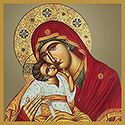
Now when we look at the original Hebrew text of this revealed name, it is spelled out using only the equivalent letters YHWH. You may have heard this referred to as the tetragrammaton, but you've more likely heard it spoken aloud simply as Yahweh. But to the ancient Hebrews this letter sequence YHWH was a name so sacred that it was not permissible to speak it aloud. It was considered an "unutterable name," and for this reason the Jews used an alternate term as a substitute, which today we hear as Adonai. Adonai translated into Greek gives us our term Κύριος, or LORD. So when we hear Thomas proclaim "ο Κύριος μου kai ο Θεός μου," — my Lord and my God — he is ascribing to Jesus this unutterable name! And incidentally, when we look upon an icon of Christ today we see the letters οων in his halo, for this is the Greek rendering of those same Hebrew letters YHWH, which points to Christ as the "Existing One" or the "One Who Has Being." This demonstrates furthermore that it was not only God who was revealed to Moses in the Burning Bush, but an early manifestation, or theophany, of Jesus Christ.
The significance of Thomas' recognition of Christ in today's Gospel reading, by referring to Him in God's unutterable name, is massive! No one up to this point had identified Christ so explicitly as God. But similar to Moses before him, Thomas' had an inexplicable encounter with God that his otherwise rational mind could not comprehend. It was only AFTER Thomas saw the marks of the crucified and risen Lord, that he was able to comprehend Israel's promised Messiah in his midst. And this is a vivid lesson for each of us. For there are many competing ideas today that challenge this understanding of the crucified and risen Christ made known to us only through the Cross.
There are some today, for example, who repeatedly exemplify Christ as a conquering king to promote war. This is a FALSE version of Jesus Christ. There are others who try to use Jesus as a tool for excluding others. This is not only a FALSE version of Jesus, but it is ignorant of Christ's ministry in the Gospel accounts. And there are others still who attempt to hyper-masculinize Christ, and in doing so make Him more human than divine. This is very clearly an inaccurate of Jesus as portrayed in the Gospels.
Now, I want to be very clear when I say this: It is not possible to understand Christ apart from the Cross. The very message passed down to us from the time of the Apostles IS the crucified Christ. Not a physical warrior, not a political leader, not culture warrior, but a humiliated, beaten, bullied, emasculated, and crucified Christ. And the way TO Jesus is through the Cross. We cannot claim to know Jesus Christ and then tack on the Cross as a postscript. Christ Himself tells us "If any wish to come after me, let them deny themselves and take up their cross daily and follow me." [1] And again he says, "Whoever does NOT carry the cross and follow me cannot be my disciple" [2] The Apostle Paul later declares: "For I decided to know nothing among you except Jesus Christ and him crucified." [3] and later still "May I never boast of anything except the cross of our Lord Jesus Christ…" [4]
Paradoxically speaking, the cross is a transformative event. The way to life, is through death. The way up is down. The way forward is not through might but through humility! Last week we witnessed the baptism of five our new catechumens. And this event stands as stark reminder to all of us that when each of us was baptized, we were baptized in to our own death. Our baptism symbolizes our recognition of Christ as Lord, and putting to death any desire to seek power, prestige, and glory. The only glory we know is the glory made manifest through Christ on the Cross.
Returning to our Gospel reading, when Thomas says that he will not believe, he is still in the mindset of the Messiah as a political leader, and he can't make sense of Christ's crucifixion. In seeing the print of the nails, and the wound in His side, Thomas' understanding is transformed. Likewise, each of us must have our understanding of Christ transformed. Thomas learned the identity of Christ as revealed through the marks of His crucifixion — through the Cross — and the divinity of Christ as proclaimed though his resurrection. When Thomas finally calls Jesus Lord he finally understands Christ by the unutterable name of Yahweh.
May each of us go forward with renewed minds, transformed by the saving work of Christ on the Cross and his subsequent resurrection that we may likewise proclaim, "My Lord and my God!"
Christ is Risen!
_________
[1] Luke 9:23 NRSVue
[2] Luke 14:27 NRSVue
[3] 1 Corinthians. 2:2 NRSVue
[4] Galatians 6:14 NRSVue