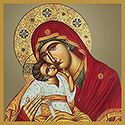
The Myrrh-bearing Women
Sermon preached by Dn. Jeff Smith on Sunday, April 26, 2026 at St. Mary Orthodox Church in Cambridge, MA
In the name of the Father and the Son and the Holy Spirit.
Today’s Gospel places us early, at dawn, quietly at the tomb of Jesus. Joseph of Arimathea has taken courage to ask for his body; Mary Magdalene and the other women keep watch. We can name them: Mary, Salome, Suzanne, and Mary and Martha, the sisters of Lazarus. They remember Jesus, and they return to his tomb in the early morning. They come not with force, but with spices and myrrh— demonstrating their devotion to him in the face of his death. And it is to them, not to the Twelve Apostles, that the news, “Christ is Risen – Al Messiah Kham - Christos Anesti!” breaks out into the world: This announcement to the myrrh bearing women is not an accident. Instead, it reveals something essential about the Kingdom of God and the human heart.
The Church has always honored the Myrrh-bearing Women as “equal to the apostles,” not because they held an office, but because they received and proclaimed the Resurrection. St. John Chrysostom notes that while all the disciples were hidden away in fear, the women came forward in love and boldness, and so they were made worthy to hear the angelic proclamation first. Their receptivity was their strength—their capacity to remain present during Jesus’ suffering at the Cross, to endure their grief without turning away, and to approach the tomb even when all hope seemed sealed away behind the stone.
Why did Christ appear to these women first? In that moment, with great courage, not knowing what they would find, they approached the empty tomb. And they were filled with wonder, but they were also open and receptive, because the truth of the resurrection can only be received as a gift. These women demonstrated an openness and willingness to stand in the space of not-knowing, to be with their sorrow instead of trying to resolve it prematurely. This is kenosis, a self-emptying that makes room for God. The women did not come to solve a mystery; they came to anoint a body. And in their humble intention, they became the first witnesses of glory.
This challenges a pattern that runs deep in human history. When Christ overturned the tables in the Temple, He confronted systems of control, transaction, and domination—structures upheld by male authority. But Christ drove a stake into the heart of that patriarchy, and He exposed the futility of power that seeks to possess, to manage, and to exclude. His Kingdom is not built on a hierarchy of domination, but with a communion of self-giving love. This creates the real possibility of transfiguration for all of us, and this is what it means to be human.
The women at the tomb embody a prophetic openness: they remain attentive to God’s action even when it defies expectation. The men, in their time, will embody another dimension—a witness through sacrifice, martyrdom, and a costly proclamation of the Gospel. These are not opposites but complementary movements within the life of the Church. And today’s Gospel invites all of us—men and women—to learn from the myrrh-bearers, to embrace a radical receptivity, and the courage to approach the empty places in our own lives instead of looking away.
Christ’s relationship with the women in his life reveals their mutual freedom. He refuses to reduce them to possessions or roles; He received from them; some washed his feet with their hair. He spoke gently with them, and he entrusted them with revelation. In calling His disciples “friends,” He set aside control and replaced it with mutuality. Friendship, in the Gospel, is not casual—it is a shared participation in beauty, goodness, and truth. The women were not only followers; they were companions who remained steadfastly at His side, when men like Peter scattered like leaves.
This has implications for our own relationships. To follow Christ is to resist the urge to dominate others in order to maintain our own security. It is to create a space where the other can stand before God freely. In our marriages, friendships, and in our communities, this means we can listen more deeply to each other, relinquish control, and honor the image of God in each other. The Resurrection opens up relationships of trust: today, an angel speaks, the women receive, and then they are sent out into the world.
I’ve read how Saint Nektarios of Aegina embodied this pattern. He worked closely with women in monastic communities, listening and advising with a recognition that holiness can flourish where there is mutual respect, humility, and a shared sense of devotion. He built these relationships as a living icon of the Church—a communion where each of our gifts are received and are offered back to God.
So what can we take away from this Gospel? First, we are called to become myrrh-bearers ourselves—to bring whatever we have, however small, to the places that seem sealed away and lifeless. Second, we can cultivate openness: and resist the need to control the outcome, and instead to wait for the Kingdom of God to reveal itself in due time. Third, we can examine more closely how we relate to each other—do we seek to possess or befriend, do we try to dominate or to serve?
Today’s Gospel ends with the women fleeing away in awe and trembling. They are utterly afraid and awestruck. But an energy is coursing through them, and it is the beginning of their transformation. The Resurrection is too great - too great to be managed, we must approach and enter the empty tomb. And those who dare to stand with the same kind of trembling openness will also become witnesses of a life that tramples down death by death.